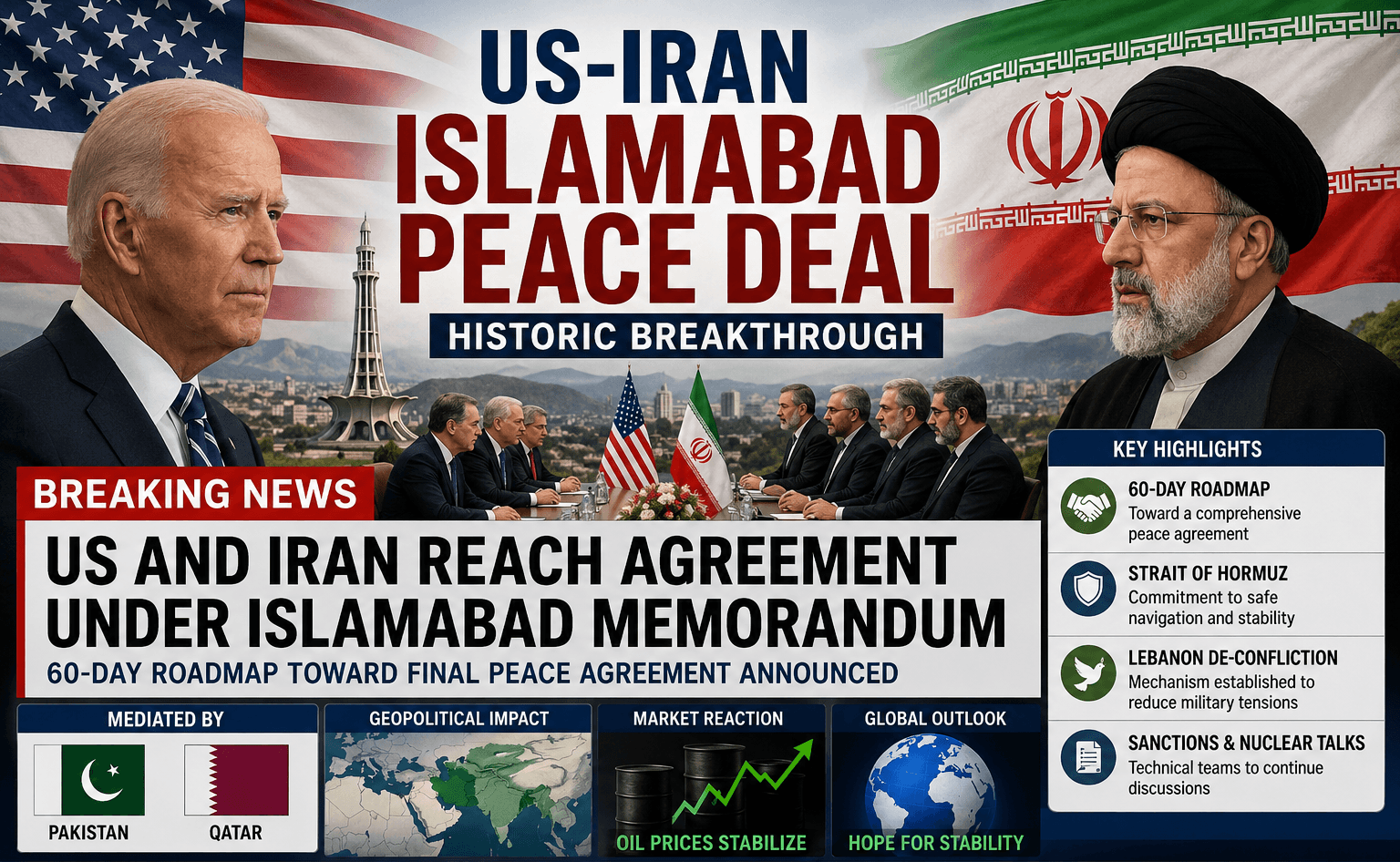
In a development that could reshape the strategic landscape of the Middle East, the United States and Iran have announced significant progress toward a comprehensive peace agreement under what has become known as the Islamabad Memorandum. Following high-level negotiations in Switzerland facilitated by Pakistan and Qatar, both sides agreed to pursue a structured 60-day roadmap aimed at transforming a fragile ceasefire into a long-term political settlement.
The agreement represents the most substantial diplomatic breakthrough between Washington and Tehran in years, arriving after months of escalating military confrontation, economic pressure, and growing fears of a wider regional war. The talks produced a framework for continued negotiations, the establishment of oversight mechanisms, and confidence-building measures designed to reduce the risk of renewed conflict. What Is the Islamabad Memorandum?
The Islamabad Memorandum serves as the political foundation for ongoing peace negotiations between the two adversaries. Initially supported by Pakistan's mediation efforts, the framework seeks to end military hostilities, restore freedom of navigation in the Strait of Hormuz, and create conditions for broader discussions on sanctions, regional security, and Iran's nuclear program.
Recent negotiations have reportedly established:
A 60-day roadmap toward a final agreement. A high-level political oversight committee. Technical negotiations on sanctions and security arrangements. Mechanisms to reduce military tensions in Lebanon. Communication channels to prevent incidents in the Strait of Hormuz. Pakistan's Emergence as a Strategic Mediator
One of the most notable outcomes of the process is Pakistan's rising diplomatic influence. Historically positioned between competing regional interests, Islamabad has successfully transformed itself into a credible mediator capable of facilitating dialogue between major geopolitical rivals.
For Pakistan, the agreement represents a significant foreign policy achievement. It demonstrates Islamabad's growing ability to act as a bridge between the United States, Gulf states, and Iran while enhancing its relevance within broader regional security architecture.
The success of the mediation effort may strengthen Pakistan's standing not only in the Islamic world but also among global powers seeking stability in a strategically vital region.
The Strait of Hormuz: The Economic Centerpiece
From a geopolitical perspective, the most critical aspect of the negotiations concerns the Strait of Hormuz.
Roughly one-fifth of global oil shipments pass through this narrow maritime corridor, making it one of the world's most strategically important energy chokepoints. Any disruption immediately impacts global energy prices, shipping routes, and economic stability.
The agreement's provisions for safe commercial navigation and direct communication mechanisms between the parties have already contributed to easing market concerns. Energy traders and governments worldwide are closely monitoring implementation, viewing Hormuz stability as a key indicator of whether the peace process can succeed.
Lebanon Becomes the First Test of the Agreement
While the framework addresses broader U.S.-Iran relations, Lebanon has emerged as the first major test case for implementation.
Negotiators agreed to establish a "de-confliction" mechanism intended to reduce tensions involving regional actors operating within Lebanon. If successful, the initiative could serve as a model for future conflict management efforts across the Middle East.
Failure, however, would raise questions about the ability of both Washington and Tehran to translate diplomatic commitments into practical outcomes on the ground.
The Nuclear Question Remains Unresolved
Despite the optimism surrounding the talks, the most challenging issue remains unresolved: Iran's nuclear program.
Current agreements focus primarily on de-escalation and confidence-building measures, while technical teams continue discussions regarding uranium enrichment, verification mechanisms, sanctions relief, and long-term compliance arrangements. Analysts widely view these negotiations as the decisive factor that will determine whether the peace process produces a lasting settlement or merely a temporary pause in tensions.
Geopolitical Winners and Losers Winners
Iran Tehran gains potential sanctions relief, access to frozen assets, and a pathway toward economic recovery while avoiding further military escalation.
United States Washington secures reduced regional tensions, safer maritime trade routes, and an opportunity to address nuclear concerns through diplomacy rather than conflict.
Pakistan Islamabad emerges as a major diplomatic stakeholder and demonstrates its capacity to influence international crisis management.
Global Energy Markets Improved security in the Persian Gulf lowers risks to global oil supply chains and international commerce.
Potential Challenges
Regional actors remain cautious. Questions persist regarding enforcement, verification, proxy conflicts, and the durability of commitments made under the agreement. Any breakdown could rapidly reverse recent diplomatic gains.
Strategic Outlook
The Islamabad Peace Deal is not yet a final peace treaty, but it may represent the most promising diplomatic opening in U.S.-Iran relations in years. The next 60 days will be critical as negotiators attempt to convert political momentum into a comprehensive settlement addressing security, economics, and regional stability.
If successful, the agreement could redefine the balance of power across the Middle East, reduce the likelihood of future military confrontation, and establish a new framework for regional diplomacy. If it fails, the region could once again face heightened instability, renewed sanctions battles, and the risk of broader conflict.
For now, the world is watching as Washington and Tehran take cautious steps toward what could become one of the most consequential geopolitical agreements of the decade.